Indonesia Fast-Tracks Law for a Dubai-Level Financial Center
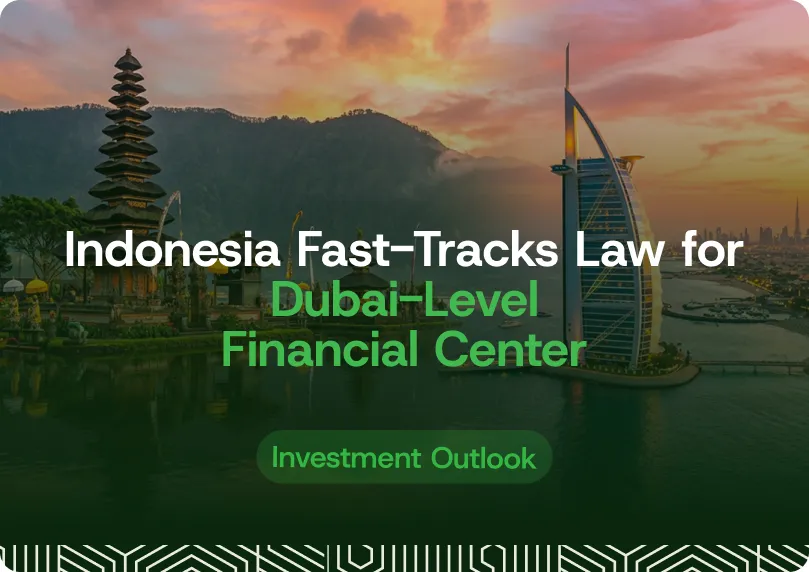
Indonesia is moving to establish its own international financial center, part of a broader national push to position the country alongside the Dubai International Financial Centre (DIFC) as a serious destination for global capital.
What's happening
The legal basis comes from the 2026 amendment to Law 4/2023 on the Development and Strengthening of the Financial Sector, known as the P2SK Law.
Under this framework, the government is now drafting a dedicated law to govern the operation of the financial center itself, as part of a wider national strategy to attract global capital into Indonesia.
Coordinating Minister for Economic Affairs Airlangga Hartarto confirmed the structural work is ongoing: "We have discussed the legal structure of the financial center. We are still drafting the law." Consultations are now underway with the House of Representatives, and the government has set a target of finalizing the law within three months of the P2SK amendment's promulgation, around September 2026.
Why a common law framework matters
One of the most notable elements of the proposal is the possible adoption of a common law system within the zone, similar to the legal structure that underpins the DIFC.
For international investors, this would mean access to a legal environment built for cross-border predictability rather than reliance solely on Indonesia's civil law system. The plan also includes an independent judiciary and a dedicated regulatory board to oversee the zone.
The investment case
Officials have been direct about the scale of ambition. Indonesia currently draws around IDR 2,200 trillion in traditional investment per year. By comparison, Singapore's financial center has attracted roughly IDR 5,000 trillion, and the DIFC manages assets of approximately USD 800 billion.
The government sees a dedicated financial center, backed by special tax incentives and economic zone benefits, as a way to close that gap and position Indonesia as a whole alongside Singapore, Hong Kong, and Dubai as a global financial hub.
What to watch
The law is still being drafted, and details on the exact tax incentives and operational mechanics are expected in a separate implementing regulation once the core legislation is finalized.
For investors watching Indonesia's broader growth story, this is a development worth tracking closely in the months ahead, as it signals the government's wider commitment to strengthening the country's position as a global investment destination.
Developments like this reinforce why Indonesia, and emerging regions like Lombok in particular, continue to draw serious attention from international investors.
If you'd like to explore what this could mean for your own investment strategy, schedule a call with one of our portfolio advisors to discuss opportunities in Indonesia.